Apple's New Siri (2026): What It Does, When You Get It, And Whether You Should Care
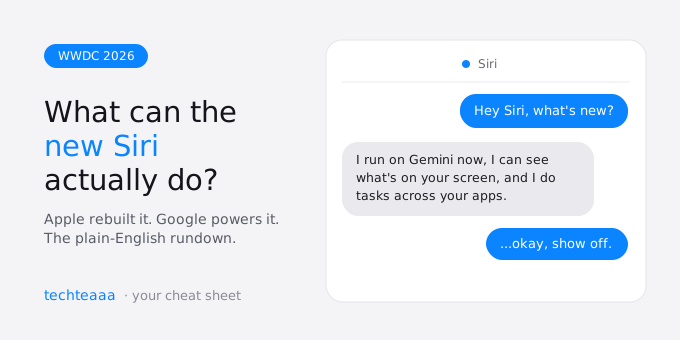
Quick verdict: At WWDC 2026, Apple rebuilt Siri from the ground up into a proper AI assistant that can hold a conversation, see what is on your screen, and do multi-step tasks across your apps. The twist nobody had on their bingo card: it runs on Google's Gemini under the hood. It arrives this fall with iOS 27, iPadOS 27, and the new macOS, but only on newer devices, and the smartest features look like they are rolling out behind a waitlist. Here is everything that actually matters:
What is the new Siri?
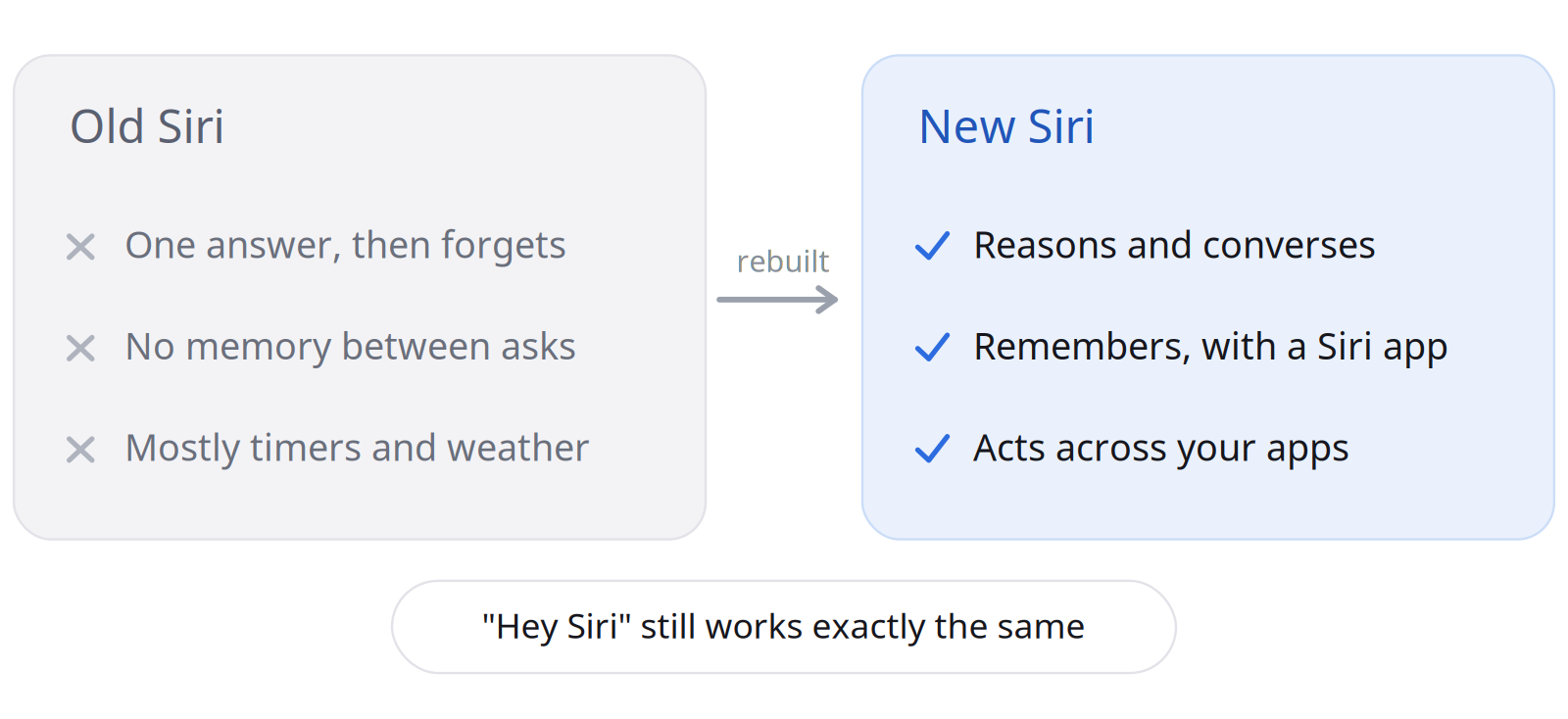
The new Siri is a complete rebuild of Apple's assistant around Apple Intelligence, turning it from a glorified timer-setter into something that can actually reason, converse, and take action for you. Apple says it can handle more complex requests and carry on longer back-and-forth conversations, and yes, "Hey Siri" still works exactly like you expect.
The big mental shift: old Siri answered one question at a time and forgot everything the second it finished. New Siri behaves more like ChatGPT or Gemini. There is now a dedicated Siri app where you can scroll back through past conversations, so a long planning session or a detailed answer does not vanish into the void after one go.
Translation for normal humans: Siri finally graduated from "set a 10 minute timer" to "help me actually get something done."
What can the new Siri actually do?
The headline new power is that Siri can now understand what is on your screen and take actions across multiple apps on your behalf. This is the "agent" part everyone keeps talking about, and it is the real upgrade.
A few concrete examples Apple showed or described:
- On-screen awareness. Siri knows what you are looking at. In one demo, someone asked Siri for directions to a landmark they spotted in an Instagram post, and Siri figured it out from the image.
- Cross-app actions. You can highlight text in an email or message and ask Siri to do something with it, like create a calendar event or pull up more context, without manually copying and pasting between apps.
- Multi-step tasks. The rebuild is designed for "draft this, find that, organise this" style requests, not just trivia. That is where it earns its keep.
- A more human voice. You can customise Siri's voice by adjusting its pace and expressivity until it sounds right to you.
Think of it less as a search box and more as an assistant you can actually delegate small chores to.
Does the new Siri use ChatGPT or Google Gemini?
The new Siri runs on Google's Gemini, not ChatGPT. This is the genuinely surprising part. Apple built the new Siri experience on top of Google's Gemini models, plugged into Apple's own cloud system, to handle the heavy, multi-step reasoning.
Why this is a big deal: Apple spent years branding itself as the company that does everything in-house. Quietly leaning on Google, its long-time search rival, to power its flagship AI feature is a major admission that catching up alone was taking too long.
It is also a reminder that "Apple Intelligence" is now partly powered by someone else's brain. Practically, you should not notice Gemini directly. It sits behind Apple's interface and privacy layer. But it is the kind of detail that tells you how the AI race is actually going.
When does the new Siri come out?
The new Siri and the related Apple Intelligence features ship this fall, alongside iOS 27, iPadOS 27, and the new macOS. Developer betas went out right after the keynote, so developers and beta testers can poke at the software now, with the public release expected in the autumn as usual.
One important catch: the smartest Siri AI features look like they are gated behind a waitlist at launch rather than flipping on for everyone at once. So even when the update lands, do not be shocked if full access trickles out in stages. Apple has not committed to a precise day, which, given how its last AI timeline went, is probably wise.
Which devices support the new Siri and Apple Intelligence?
Apple Intelligence and the new Siri need fairly recent hardware. Here is the supported list:
- iPhone 15 Pro and later
- iPhone 16 and later
- iPad mini with the A17 Pro chip
- iPad with M1 or later
- Mac with M1 or later
- Recent Apple Watches (watchOS 27 gets the same Siri overhaul)
If your device is older than that, you can still update to the new OS in many cases, but the AI brain stays locked. The reason is simple: this stuff is hungry for processing power and memory, and older chips cannot keep up.
Is my iPhone getting iOS 27?
iOS 27 supports iPhones going back to the iPhone 11, so a lot of older phones get the update itself. The thing to understand is the split: getting iOS 27 and getting the new Siri AI are two different things. Your iPhone 11 can run iOS 27 and enjoy the smaller improvements, but the headline Apple Intelligence and Siri features require the newer chips listed above. So check both boxes before you get excited.
Is the new Siri private and safe?
Apple is positioning privacy as the whole selling point, though it is fair to stay a little skeptical. On stage, Apple software chief Craig Federighi insisted that privacy in AI is non-negotiable and that your data is only used to carry out your request. Apple's design keeps lighter tasks on your device and sends heavier ones to a locked-down cloud system rather than letting an outside company freely train on your data.
The honest caveat: some early independent research has already questioned how well Apple's on-device AI lives up to the privacy and performance promises. So treat the privacy pitch as a strong intention backed by real engineering, not a finished, proven guarantee. We will know more once it is in millions of hands.
Is the new Siri better than ChatGPT or Gemini?
Probably not better in raw smarts, but that is not really the point. ChatGPT, Gemini, and Claude are still the heavyweights for pure conversation and reasoning, and Apple is using Gemini precisely because it could not match them alone.
Where the new Siri could win is integration. It is baked into your phone, your apps, your messages, your calendar, and your photos, with permission to actually do things in them. A standalone chatbot can tell you what to do. Siri is trying to just do it for you. Convenience beats raw IQ for most everyday tasks, so for a typical user, "the assistant that is already everywhere and can act" may matter more than "the assistant with the highest benchmark score."
What else did Apple announce at WWDC 2026?

Beyond Siri, Apple spread AI across a bunch of everyday apps. The highlights:
- Photos editing. New tools include Clean Up (removes unwanted objects), Extend (adds image beyond the original frame), and Reframe (shifts a photo's perspective after you have taken it).
- Passwords. Smarter help to spot and fix weak passwords, including quicker one-tap updating.
- Wallet. A bill-splitting feature where you photograph a receipt and generate payment requests for friends, plus a "Create a Pass" option to turn physical tickets and cards into digital passes.
- Parental controls. A new "Time Allowance" system for highly customised app limits and schedules, and "Ask to Browse," which lets kids request website approval right inside Messages. Apple is also opening these guardrails to third-party apps.
- Design. More visual tweaks to the "Liquid Glass" interface across all platforms.
There were also code-level hints of a foldable iPhone buried in the iOS 27 beta, but Apple did not announce one, so file that under rumour, not fact.
Do I have to pay extra for the new Siri?
Apple did not announce a separate subscription for the new Siri or Apple Intelligence. The real cost is hardware: the features are tied to owning a supported device, so for many people the "price" is upgrading to a newer iPhone, iPad, or Mac rather than paying a monthly fee. If you already own a recent device, you are set.
techteaaa verdict: should you care?
Yes, but keep your expectations on a leash. This is the most serious AI effort Apple has ever made, and the agent style Siri, the on-screen awareness, and the cross-app actions are genuinely useful for normal daily life. The fact that Apple swallowed its pride and brought in Google Gemini tells you it is finally taking this seriously.
But this is also the company that overpromised on AI in 2024 and made everyone wait. So the smart move is to judge it when it actually ships and works on your device, not from a polished keynote demo. Big potential, real features, and a healthy reason to wait and see.
New Siri and WWDC 2026 FAQ
This fall, with iOS 27, iPadOS 27, and the new macOS. The smartest features may roll out behind a waitlist, and Apple has not given an exact date.
Yes. Apple built the new Siri on Google's Gemini models, connected to its own cloud system.
Apple Intelligence and the new Siri need iPhone 15 Pro and later, or iPhone 16 and later. Older iPhones can run iOS 27 but not the full AI features.
iOS 27 supports iPhones back to the iPhone 11, but those will not get the new Siri AI features.
There is no announced subscription. You just need a supported device.
Not necessarily smarter, but far more integrated into your phone and apps, which matters more for everyday tasks.
Yes, the familiar ways of using Siri still work, including "Hey Siri."
Sources
- Apple WWDC 2026 keynote coverage from TechCrunch, CNBC, Fox News, Tom's Guide, and NPR, June 8 to 12, 2026
This is techteaaa, signing off.